



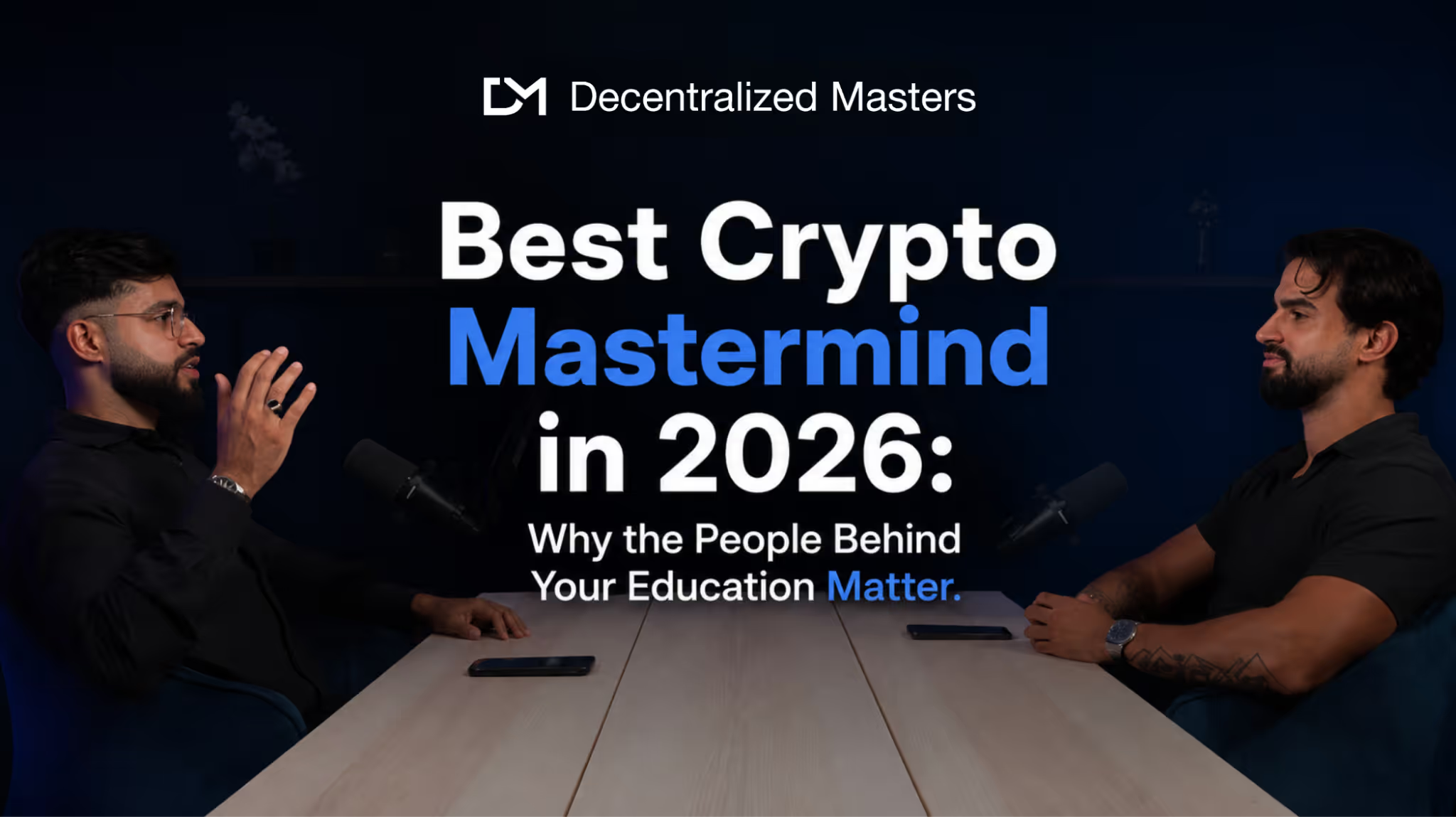
The best crypto mastermind is not a Discord server. It’s not a YouTube channel with a paid tier. It’s not a pre-recorded course built by someone who had a good cycle and decided to start teaching.
A real crypto mastermind is defined by the people running it.
- Their credentials.
- Their frameworks.
- Their willingness to sit across from you, one on one, and walk you through exactly what they know.
There is a version of crypto education that tells you what to buy. There is another version that teaches you how to think. The difference between those two things is the difference between following someone else's conviction and building your own. Between reacting to the market and understanding it. Between a good cycle and a system that works across all of them.
This post is about what the best crypto mastermind in 2026 actually looks like. Specifically, it is about the two people who built the programme that 4,500+ serious investors chose, and why what they created is the answer to a question most people in this space are not asking loudly enough: who, exactly, is teaching you?
What Makes a Best Crypto Mastermind Worth Joining
Before joining any crypto mastermind group, most people ask the same questions. How much does it cost? What is included? Are there testimonials? Is there a community?
These are reasonable questions. But they are not the most important one.
The most important question is: who built this, and what qualifies them to teach it?
In traditional finance, this question answers itself. If someone is advising you on portfolio construction, you want to know whether they have a CFA. Whether they have managed institutional capital. Whether they have a track record across different market conditions, not just a bull run.
In crypto education, these standards are rarely applied. The space is full of content creators with large audiences and limited professional backgrounds who built a following during a rising market and converted that following into a paid community. The content may be useful. The format may be engaging. But the person teaching it has not managed institutional capital, has not applied hedge fund frameworks to a portfolio, and has not spent years inside the financial infrastructure they are now teaching people to move away from.
This is the gap that Tan Gera and Salim Elhila identified in 2022. And it is the gap Decentralized Masters was built to close.
Two People. Two Worlds. One Shared Conviction.
The story of Decentralized Masters is, at its core, the story of two people who came from opposite ends of the professional world, arrived at the same conclusion, and built something neither could have built alone.
Tan Gera: The Institutional Framework

Tan Gera was born in Paris in 1995. By 23, he had already done something most finance professionals spend a career working toward: he passed all three levels of the CFA programme, ranking in the top 5% globally.
That credential is not decorative. The CFA programme is one of the most rigorous qualifications in finance, covering portfolio management, asset valuation, risk frameworks, and financial analysis at the institutional level. Passing all three levels before the age of 24 is rare. Doing it while simultaneously beginning a career in investment banking is rarer still.
Tan's career took him through some of the most demanding environments in global finance. He began in a Parisian hedge fund, working alongside portfolio managers overseeing more than $2 billion in assets. He then moved into mergers and acquisitions investment banking, working on large corporate transactions on both buy and sell sides, across Paris, Amsterdam, and New York.
He was, by any conventional measure, exactly where you would expect someone with his credentials to be.
But being inside that system gave him a perspective on its limitations that very few people have. He was advising corporations worth billions. He was applying the same sophisticated portfolio management principles used by the world's largest institutions. And he could see, clearly, that those frameworks were not accessible to individual investors navigating their own financial futures.
The tools existed. The knowledge existed. The frameworks that protected and grew institutional capital were real and proven. They were just not being taught to the people who needed them most.
"I was advising corporations worth billions, applying sophisticated portfolio management principles that delivered consistent returns," Tan has said.
The question that followed him out of investment banking was a simple one: why should those principles stay behind the walls of the institutions that built them?
In 2022, he co-founded Decentralized Masters to answer it.
Salim Elhila: The Analytical Infrastructure
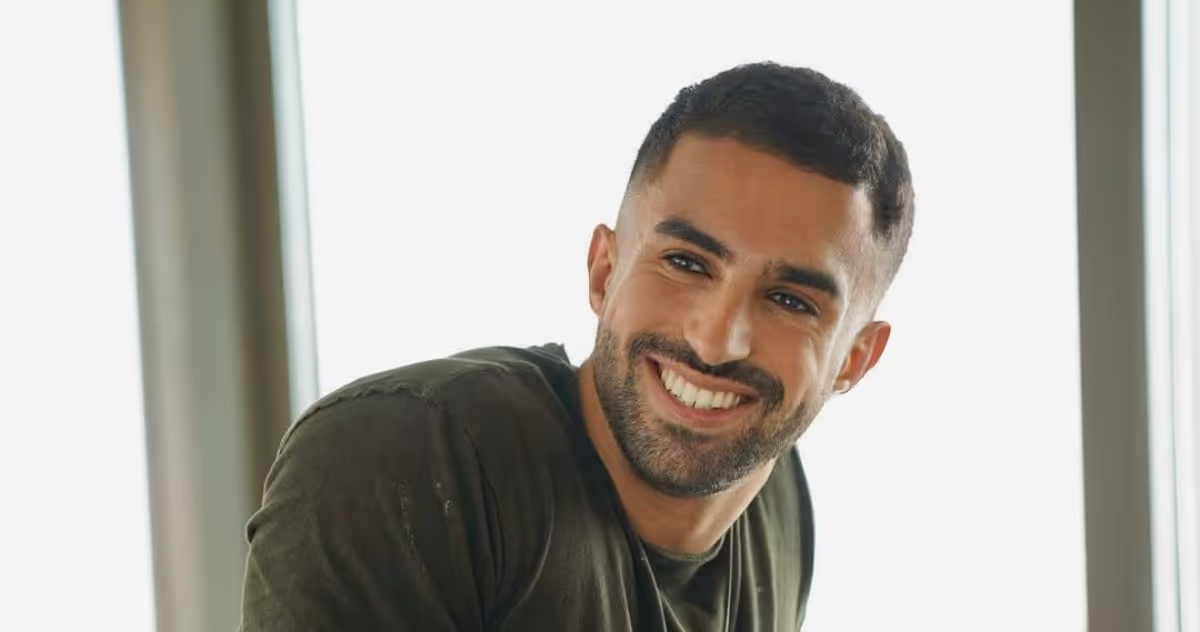
While Tan was navigating investment banking in Paris and New York, Salim Elhila was building something entirely different, from the ground up, in the world of technology and entrepreneurship.
Born in Paris in 1993, Salim studied at INSA Toulouse, earning a degree in mathematical engineering with a specialisation in statistics, data modelling, and artificial intelligence. That technical foundation set the direction for everything that followed.
Salim is, at his core, a builder. He has founded and scaled multiple ventures across Web2 and Web3, collectively generating over $100 million in sales. His background in mathematical modelling and AI gives him a way of reading markets, identifying patterns, and building analytical systems that is fundamentally different from the qualitative judgement most crypto educators rely on.
His entry into crypto came through Web3 entrepreneurship. He was managing the marketing side of MetaLegends, a Web3 project that sold out for $20 million, when he realised the pace and scale of what was happening in the space. It was during that period that he met Tan.
The combination was immediate and obvious. Tan had the institutional finance framework. Salim had the analytical infrastructure and the entrepreneurial instinct to build a system around it. Between them, they had something the crypto education space had almost never seen: genuine professional credentials on both sides of the equation.
"By that time, I met Tan," Salim said of that period. What followed was a shared conviction that DeFi education needed to be rebuilt from the foundation. Not as content. As a framework.
Why They Built the Best DeFi Mastermind They Wished Had Existed
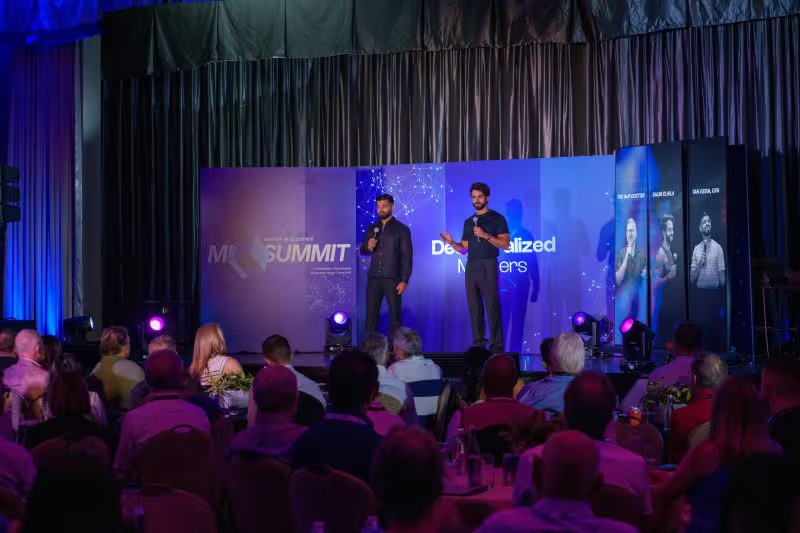
Decentralized Masters launched in 2022, at one of the most difficult moments the crypto market had seen in years. The FTX collapse happened weeks after the platform launched, wiping billions in value from the space and destroying the confidence of millions of investors who had trusted centralised platforms with their capital.
The timing was not a coincidence. It was the point.
Tan and Salim did not build Decentralized Masters because the market was easy. They built it because the market had made it abundantly clear that most people in crypto did not have the framework to navigate what was coming. They were speculating without structure, trusting without verification, and making decisions based on social media narrative rather than fundamental analysis.
The programme they built was designed to solve that problem at the root. Not by telling people what to buy, but by teaching them how to evaluate what they were looking at. Not by providing signals, but by building the analytical capability to generate their own.
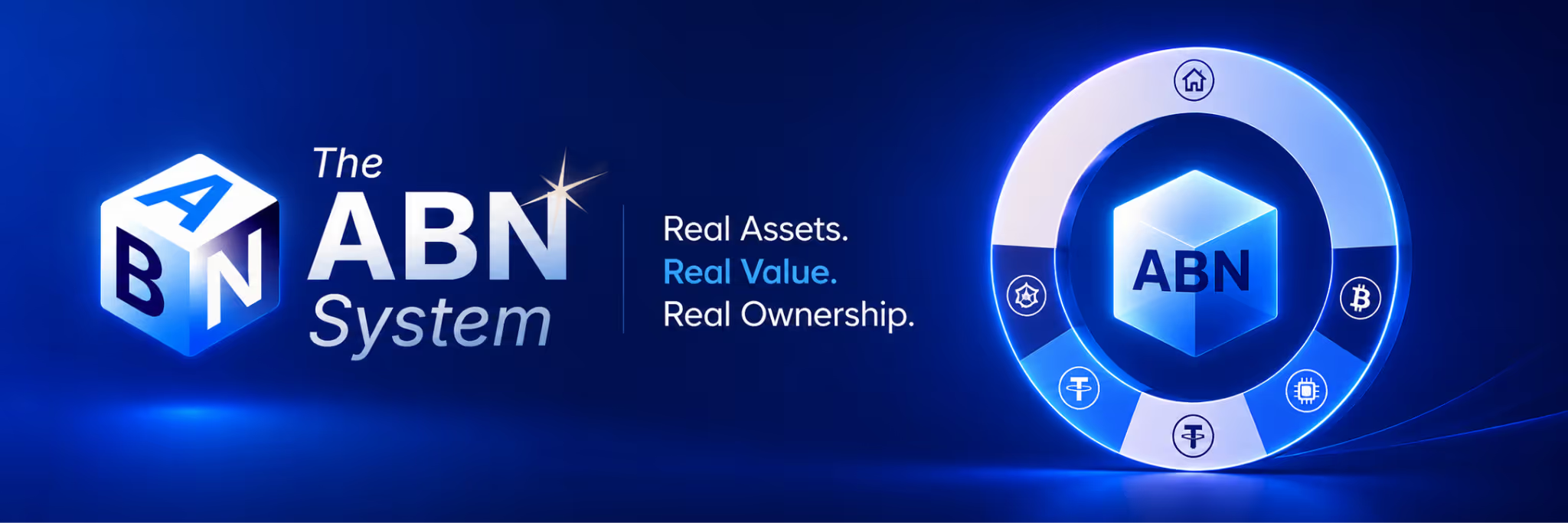
The ABN System is the direct output of their combined expertise. Tan's institutional framework is translated into a three-phase wealth-building model adapted for digital assets. Salim's analytical infrastructure is embedded into the research layer that sits behind every mentor and every portfolio decision.
It is, in the most literal sense, the mastermind they wished had existed when they were building their own understanding of this market.
What the Best Crypto Mastermind Actually Delivers
The word mastermind is used loosely in the crypto education space. It is worth being precise about what it means inside the best crypto mastermind programme available today, because the definition matters.
A crypto mastermind is not a course. A course is a structured learning experience you complete at your own pace. Useful for some purposes. Not the same as a mastermind.
A crypto mastermind group is not a community. A Discord server with thousands of members sharing market reaction and token alerts is a community. Also useful. Also, not a mastermind.
The best DeFi mastermind has three things that distinguish it from everything else.
- The founders have genuine, verifiable credentials. Not following. Not a track record of good calls during a bull market. Institutional qualifications, professional experience managing real capital, and a framework that has been stress-tested in environments most crypto educators have never been inside.
- The mentorship is direct and personalised. Not a group call. Not a pre-recorded module. A person who has done what you are trying to do, working with you directly on your specific situation.
- There is a research infrastructure behind the mentorship. The mentor does not operate on instinct or opinion. They operate within a system that has been built and maintained by a team of analysts applying institutional-grade frameworks to every decision.
Decentralized Masters delivers all three. Here is what that looks like in practice.
The ABN System: Built by Two Masterminds, Delivered by One-on-One
The ABN System is the operational heart of Decentralized Masters. A three-phase wealth-building framework developed by Tan and Salim that takes members from structural foundation through passive income generation to early-stage market access.
Every phase builds on the previous one. The order is not a suggestion. It is what makes the system work.
Phase A: The All-Weather Portfolio
Phase A is the foundation. Inspired by Ray Dalio's proven all-weather portfolio framework and adapted for digital assets by Tan's institutional background, Phase A structures a diversified portfolio across six categories of tokenised assets designed to withstand volatility, inflation, and market crashes. It is not built for a bull market. It is built for any market.
Every member goes through Phase A with a 1-on-1 mentor: a seasoned investor who has personally built and managed an all-weather digital portfolio themselves. This is the direct expression of Tan and Salim's conviction that real learning requires real guidance. Not a coach reading from a script. Not a community manager pointing you toward a module. Someone who has been through what you are navigating, who understands the specific decisions in front of you, and who works with you to build an allocation based on your goals, risk tolerance, and capital.
Behind the mentorship layer is a 35+ person institutional research team that vets every asset eligible for member portfolios. The team uses the same fundamental analysis frameworks applied at major hedge funds, adapted for digital assets. Your mentor is not improvising. They are operating within a system built by an ex-investment banker and an AI engineer who spent years inside the institutions those frameworks came from.
Phase B: Become the Bank
Once the all-weather foundation is in place, Phase B positions your portfolio to generate passive income 24 hours a day, 7 days a week, regardless of market direction.
Stablecoin yield strategies that generate consistent returns without price exposure. Blue-chip DeFi protocols with audited track records. Tokenised real assets that bring the yield of real estate, metals, and bonds onto the blockchain without the management overhead.
This is Salim's analytical infrastructure at work. The protocols selected for Phase B are not chosen based on community narrative or trending topics. They are evaluated using the mathematical modelling and statistical frameworks Salim developed across a decade of building data-driven businesses.
You stop speculating. You start earning the way the institutions earn: collecting fees and interest on capital, systematically, in any market condition.
Phase N: Native Market Access
Phase N provides access to early-stage crypto markets before assets reach centralised exchanges. Members deploy profits generated from Phases A and B, not their original capital, to access opportunities at native market prices before the mainstream catches up.
The frameworks applied to Phase N decisions are the same ones developed for Phases A and B: fundamental analysis adapted from institutional practice, applied to early-stage digital assets by a research team that has been built specifically for this purpose.
The foundation is never put at risk. The asymmetric upside is real. The downside is managed.
Ready to build your all-weather portfolio before Q4? Book a call with the Decentralized Masters team.
Why One-on-One Mentorship Is the Only Model That Actually Works
There is a reason the most elite education in the world is delivered one-on-one.
Medical school has lectures. It also has residencies, where a trainee works directly beside an experienced physician, making real decisions under real supervision. Law schools have moot courts and clinics. Business schools have mentorship programmes that pair students with practitioners who have built what the student is trying to build.
The information layer matters. But the transformation layer, the point at which knowledge becomes capability, almost always happens in a direct relationship between someone who has done it and someone who is learning to do it.
Crypto is no different. In fact, the stakes make it more true. A person can understand liquidity pools conceptually and still freeze when they try to connect a wallet for the first time. They can know the theory of position sizing and still overallocate during a moment of excitement. They can understand risk management intellectually and still make an emotional decision when the market moves against them.
A 1-on-1 mentor sees those moments. They can catch the mistake before it costs you. They can sense-check the decision you are about to make. They can tell you, from experience, whether what you are feeling is rational or reactive.
According to MentorcliQ's 2026 research, 98% of Fortune 500 companies run formal mentoring programmes because mentored professionals advance significantly faster than their self-taught peers. The principle is not unique to crypto. But in a space as technically complex and emotionally charged as DeFi, the gap between mentored and unmentored investors is wider than almost anywhere else.
At Decentralized Masters, mentors are available for up to 12 hours per day. Not a monthly call. Not a group session where your specific question gets lost in the queue. Ongoing, direct, personalised guidance as you move through the programme and as market conditions evolve around you.
This is the direct legacy of Tan and Salim's conviction that the way institutional knowledge gets transmitted is through people, not platforms.
What the Members Who Got It Right Did Differently
The investors who have come out of the past 18 months ahead in crypto did not all start with more capital or more knowledge than those who did not. The pattern across the Decentralized Masters community is more consistent than that.
They found the right people before the right moment. The professionals positioned well for Q4 2026 did not wait until October to start building their foundation. They committed to a system in Q1 and Q2, with a mentor who had been through at least one full market cycle, and they built from there.
They used a framework instead of following narratives. While the broader market rotated through trending tokens and social media momentum plays, DM members were working through a structured allocation process backed by institutional research. The cycle rewarded them for it.
They had someone to call when things got emotional. Every market has its moments of extreme fear and extreme greed. The investors who navigate those moments well are almost never the ones operating alone. They are the ones with a mentor who has seen it before.
"The initial appeal was one of the cofounders, Tan, having a background in finance as a Chartered Financial Analyst. I have a master's degree in financial planning and really connected with the way DM integrates behavioral finance concepts and disciplined deployment of capital into their investment strategies. I've been in the digital assets ecosystem since 2017 and made (and lost) hundreds of thousands of dollars by dumb luck and costly mistakes. Simply put, you don't know what you don't know."
Joseph Cardon ★★★★★
"I had been involved in crypto for years but never really knew what to do with it other than hold it. This has opened up a whole new world to me, where I actually feel confident making much bigger moves."
Jude Tallman ★★★★★
"My mentor explains why we are doing something and does not just tell you how to do it. He has also been patient and proactive about guiding me through the process of securing my assets on the ledger and entering liquidity pools."
Marcus Worsley ★★★★★
"This is the best and most helpful crypto programme I have ever invested in. It is by far the best information I have ever received, bar none. My only regret is that I didn't join sooner."
Michael Moore ★★★★★
900+ five-star reviews on Trustpilot. Featured in Forbes, Nasdaq, and Entrepreneur. Members have reported 68% portfolio gains, a 176% APR on yield strategies, and passive income streams that cover real monthly expenses. These are not outliers. They are the result of a system built by two of the most credentialled people in DeFi education, delivered by a mentor who has done what you are trying to do.
The Bottom Line: What the Best Crypto Mastermind in 2026 Looks Like
The best crypto mastermind in 2026 is not the one with the largest community or the most aggressive marketing.
It is the one built by people who came from the institutions that created the frameworks now being applied to digital assets. The one where your 1-on-1 crypto mentor has personally built what you are trying to build. The one with 35+ analysts behind every recommendation and a research infrastructure designed from the ground up to give retail investors the tools previously reserved for institutions.
Trust in financial education does not come from a landing page. It does not come from a follower count or a highlight reel of someone's best trades.
It comes from knowing who is behind the programme, what they have built. Where did they come from? What they risked to get there. And whether the frameworks they are teaching have been tested in the real environments they claim to come from.
That is a standard most crypto masterminds cannot meet. Not because they lack good intentions, but because the people running them have not spent years inside the institutions that developed the frameworks they are now teaching.
Tan Gera has. A CFA charterholder who ranked in the top 5% globally, who spent years in hedge funds and investment banking advising corporations at an institutional scale, who understood the gap between how serious capital is managed and what most retail investors are left with.
Salim Elhila has. An AI engineer and mathematical modelling specialist who built over $100 million in sales across Web2 and Web3, who brought the analytical infrastructure to translate Tan's institutional knowledge into a system that works for individual investors.
When 4,500 members chose Decentralized Masters, they were not just buying access to a programme. They were placing trust in two people whose credentials they could verify, whose backgrounds they could research, and whose frameworks they could trace back to the institutions that created them.
That is what trust in financial education actually looks like. Not a promise. A provable track record.
You know who built this. You know where they came from. You know what they built and why.
The only question left is whether you are ready to build with them. Book your call with Decentralized Masters.
Disclaimer: This content is for educational purposes only and does not constitute financial advice. Cryptocurrency investments carry risk. Past member results do not guarantee future performance. Always conduct your own research before making financial decisions.