

From free university lectures to full mentorship programs, here is an honest ranking of where to actually learn to invest in 2026, and who each option is really for.
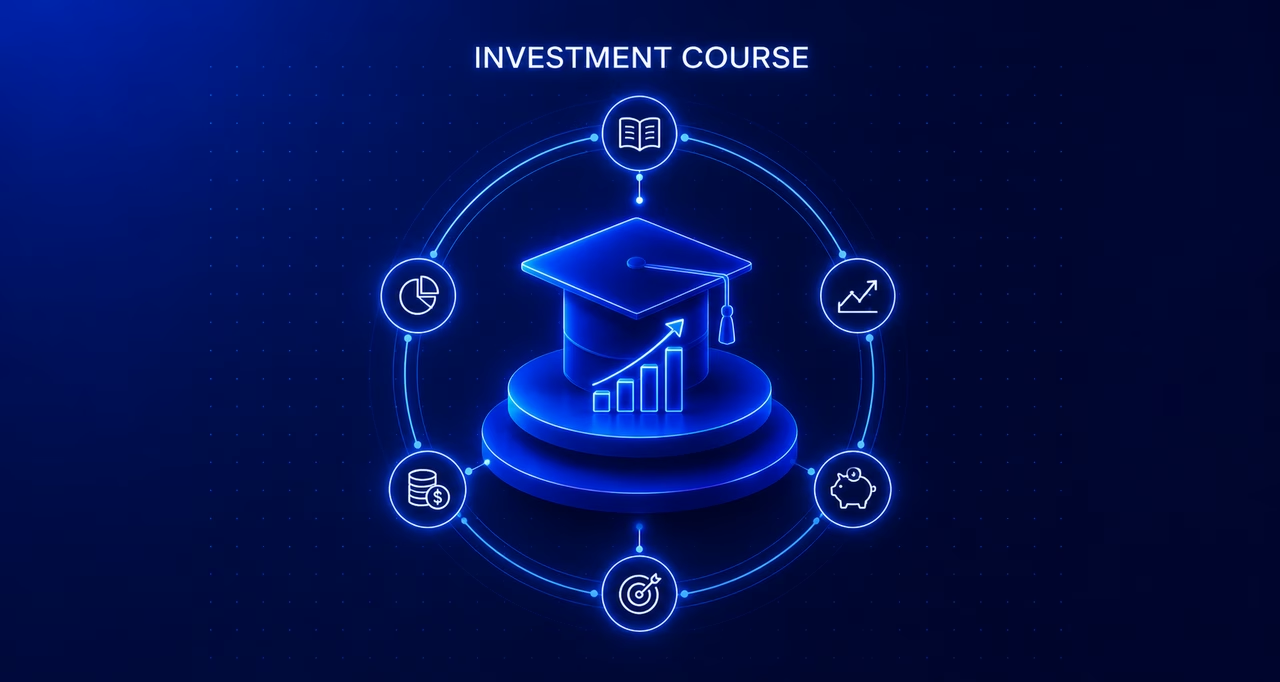
Finding the best investment course in 2026 can be difficult because the word "course" covers everything from a free ten-minute video to a multi-thousand-dollar mentorship.
Really, “best” comes down to what you need and what type of person you are.
A retiree who wants to understand index funds and a self-directed investor building a portfolio across stocks and digital assets need very different things.
So we’re not picking a single winner. This is a list of six investment courses ranked by what they actually do well, from the best value for serious investors down to the options that just cover the basics.
The one thing worth saying up front: the best investment course is the one that changes what you do, not just what you know. Free theory is everywhere. The gap most people never close is turning that theory into a portfolio they can actually manage.
Keep that test in mind as you read.
What separates the best investment course from a pile of videos
Four things:
- Breadth: does it cover the asset classes you actually want to invest in, or just one slice?
- Structure: Is there a path from beginner to competent, or a random library you have to self-assemble?
- Accountability: Is anyone checking your work, or are you on your own?
- Honesty: Does it teach about risk and downside as seriously as it teaches about upside?
The 6 best investment courses in 2026
1. Decentralized Masters: best for structure, mentorship, and all-asset coverage

For the investor who wants a real plan and someone to hold them to it, Decentralized Masters ranks first. It was founded by Tan Gera, a CFA charterholder and former investment banker who spent his career inside institutional finance, and Salim Elhila, an AI engineer and mathematical-modeling specialist.
The founders have also been covered in recent media, including a feature on Decentralized Masters founders and blockchain-powered entertainment.
That pairing of institutional discipline and quantitative rigor is a different pedigree from the typical online-course creator, and it shapes what DM is: a full-spectrum investment education and research company spanning macro, public equities, private markets, and digital assets, rather than a single-topic class.
It is also why the curriculum runs on the same portfolio-construction and risk frameworks professional money managers use, rather than on hype.
The starting point is not a hot asset; it is the question every serious investor is asking as central banks, rates, and liquidity shift: where does money go next?
DM teaches members to answer that across asset classes, and its core framework, the ABN System, turns the answer into a portfolio:

- Phase A builds a macro-diversified, all-weather portfolio across stocks, gold, bonds, real assets, and digital assets, designed to hold up in any rate or inflation regime.
- Phase B turns those assets into income through digital-asset and stablecoin yield, an alternative to leaving cash earning next to nothing in a bank.
- Phase N targets early-stage, on-chain digital-asset opportunities before they reach major exchanges, with strict risk rules.
That framework is the foundation, not the ceiling. The company is expanding into a dedicated public-equities program and into private-market and angel-investing communities, so members learn to put capital to work wherever the opportunity is, not just in one corner of the market.
What sets it apart from a video library is the human layer.
Members are paired with a 1-on-1 mentor and backed by a 35+ person research team, so the education is applied to your actual portfolio, not delivered in the abstract. It holds a 4.8 rating on Trustpilot with 900+ five-star reviews and more than 4,500 members.There are also public member discussions, including this Decentralized Masters experience thread, where people share what they looked for before evaluating the program.
None of that makes it right for everyone, so here is the honest balance. For readers comparing Decentralized Masters against other investment education programs, this Reddit discussion on how Decentralized Masters compares to other programs gives additional community context.
Pros:
- Full coverage across macro, stocks, private markets, and digital assets
- 1-on-1 mentorship plus a 35+ person research team
- Built by a CFA charterholder and an AI engineer, and applied to your real portfolio
Cons:
- A premium program, not a free afternoon of videos
- Requires genuine commitment and time
- More than you need if you only want to skim the basics
2. Yale Financial Markets (Coursera): best free academic foundation

Taught by Nobel laureate Robert Shiller, this is the gold standard for understanding how markets actually work. Across roughly 33 hours spread over seven modules, it covers the fundamentals most investors skip:
- Risk and insurance fundamentals
- Behavioral finance
- How stocks, bonds, and options are priced
- How banks, brokers, and exchanges fit together
Shiller, who won the Nobel Prize for his work on asset prices and flagged both the dot-com and housing bubbles, teaches it himself, and that authority shows in how the material ties theory to real market history.
It has drawn over 2.3 million learners, which makes it one of the most-taken finance courses in the world, and it is free to audit, with a paid Yale-branded certificate if you want the credential.
The lectures are genuinely engaging rather than dry, and the behavioral-finance sections in particular explain why intelligent people still make bad money decisions, which is worth the time on its own.
The trade-off is that it is academic, not practical. You will finish understanding why markets behave as they do, but not with a portfolio built or a single trade placed, because the focus is on theory and history rather than what to buy on Monday.
Treat it as the foundation under everything else on this list, best paired with something more hands-on. For a free education in how finance really works, nothing here beats it.
Here is how it balances out.
Pros:
- Free to audit, taught by a Nobel laureate
- Deep grounding in how markets really work
- Engaging, with strong behavioral-finance material
Cons:
- Academic, not hands-on
- No portfolio built by the end
- Certificate costs extra
3. Rice University Investment and Portfolio Management (Coursera): best structured beginner specialization

This four-course specialization is the most structured self-study path on the list.
Over about 15 weeks, at roughly 10 hours a week, it walks beginners from global markets and instruments through constructing portfolios that manage risk, understanding the behavioral biases that trip investors up, and evaluating performance, before finishing with a hands-on capstone project. No prior experience is required.
What makes it stand out is the sequence. Rather than a single lecture series, it builds skill by skill, and the capstone forces you to apply portfolio-selection and risk-management concepts rather than just watch them. Like other Coursera content, it is free to audit, with a fee only if you want the certificate, so the knowledge itself costs nothing.
Where the Yale course explains markets, Rice teaches you to construct and manage a portfolio, which makes it more applied.
What it still cannot give you is feedback on your actual money or a person to check your decisions; it is university-grade structure delivered as self-study, and you supply the discipline.
For a motivated learner who wants a clear curriculum and a real sequence without the price of a mentorship, it is an excellent middle ground.
The trade-offs come out like this.
Pros:
- Structured four-course sequence with a capstone
- Applied and beginner-friendly
- Free to audit
Cons:
- Self-study, no personal feedback
- Around 10 hours a week over several weeks
- Certificate costs extra
4. Investopedia Academy: best self-paced paid modules

Investopedia Academy is the polished, paid middle option, and it carries a name most investors already trust for definitions and explainers. Its library now spans over 40 self-paced courses, most priced around $199 for lifetime access, covering topics like stock trading, technical analysis, options, and day trading.
Several are taught by working practitioners, including former Wall Street trader David Green and Chartered Market Technician J.C. Parets, so the instruction comes from people who have actually done the job.
The experience is clean and well produced: interactive modules, quizzes, downloadable tools, and progress tracking, plus free access to past webinars. Because each course is self-contained and bought once, you can go deep on a single skill, say technical analysis, without committing to a broader program or an ongoing subscription.
What you are buying is production quality and credibility, not personalization. No mentor is reviewing your portfolio, and no accountability beyond your own follow-through, so it rewards a self-motivated learner who already knows which skill they want to build.
If you want more depth and structure than free videos, but do not need someone guiding your actual decisions, it is a reasonably priced way to level up one topic at a time.
Here is how it nets out.
Pros:
- Polished, self-paced, lifetime access
- Taught by working practitioners
- Trusted brand, 40+ topics
Cons:
- Around $199 per course
- No mentor or accountability
- One skill at a time, not a full program
5. Udemy investing courses: best budget and à la carte option

Udemy is the budget, à la carte option, and the sheer scale is the draw.
Beginner courses like Stock Market Investing for Beginners have been taken by hundreds of thousands of students, longer ones run 17 hours or more, and prices frequently drop under $100 on sale, with lifetime access once you buy.
Whatever narrow topic you want, from dividend investing to reading candlestick charts, there is almost certainly a course on it, and you can buy only the one you need.
That openness is also a weakness. Anyone can publish on Udemy, so quality swings from genuinely excellent to close to worthless, and the only way to tell them apart is instructor track record, ratings, review count, and how recently the course was updated.
A little due diligence before buying goes a long way.
Used well, it is superb for cheap, targeted skills and a low-risk way to test whether a subject clicks for you before spending more elsewhere. Used as your whole education, it falls short, because you are stitching a path together from separate, uneven pieces rather than following one coherent curriculum from beginner to confident investor.
Think of it as a toolbox, not a program.
Pros:
- Cheap, often under $100, with lifetime access
- Huge range of specific topics
- Low-risk way to test whether a subject clicks
Cons:
- Uneven quality, anyone can publish
- No coherent path or accountability
- Needs vetting before you buy
6. Khan Academy: best free starting point for total beginners

If you are starting from zero and want to spend nothing, Khan Academy's Finance and Capital Markets section is the best free on-ramp there is.
It explains the true fundamentals clearly and patiently: what it means to own equity versus lend through a bond, how bond prices move inversely to interest rates, what market capitalization really measures, and how securities and yield curves actually work, all through short, plain-English lessons you can watch in any order.
The teaching style is its strength. Concepts are broken down step by step with simple visuals, so ideas that sound intimidating elsewhere become obvious here, and none of it is trying to sell you anything.
What it will not do is take you into portfolio construction, active strategy, or any plan for your own money; it is explanation, not application, and it stops well short of telling you what to actually do.
As a first step, before you pay for anything, or a free reference to fill gaps later, it is hard to beat, and there is no reason not to start here.
In short, here is the balance.
Pros:
- Completely free
- Clear, patient fundamentals
- No sales agenda
Cons:
- Basics only, no portfolio strategy
- No structure toward a goal
- Explanation, not application
So which investment course should you choose?
Match the tool to the person.
If you want free theory, start with Khan Academy and Yale. If you want structured self-study, Rice or Investopedia Academy. If you want one cheap skill, Udemy.
And if you want a complete system with mentorship and coverage across stocks and digital assets, that is where Decentralized Masters earns the top spot.
The others teach you about investing. A mentorship-led program is built to change what you actually do with your money.
Frequently asked questions
What is the best investment course for beginners?
For free fundamentals, Khan Academy and Yale's Financial Markets are the strongest starting points. For a structured path with guidance as you begin investing real money, a mentorship-led program like Decentralized Masters closes the gap between theory and action faster.
Are free investment courses good enough?
For understanding concepts, yes. Free courses from universities and Khan Academy teach the theory well. Where they fall short is application: building an actual portfolio, sizing risk, and staying disciplined. That is usually where paid, accountable programs add their value.
How much does a good investment course cost?
It ranges from free (Khan Academy, auditing Coursera) to around $199 per module (Investopedia Academy) to premium four-figure mentorship programs. Price tracks how much personalization and accountability you get, not just content volume.
Should an investment course cover crypto as well as stocks?
Increasingly, yes. Modern portfolios often span both, so a course limited to one asset class leaves a gap. Look for investment education that treats stocks, crypto, and other digital assets as parts of one strategy rather than separate worlds.
Sources
Disclaimer: This article is for educational and informational purposes only and does not constitute financial, investment, legal, or tax advice. Decentralized Masters is an investment education and research company; it does not offer or sell securities or financial products and makes no guarantee of results. Course names, prices, and details are approximate and accurate as of mid-2026; verify current information with each provider. All investing carries risk, including the possible loss of capital. Always do your own research and consult a licensed financial advisor before making any investment decision.