


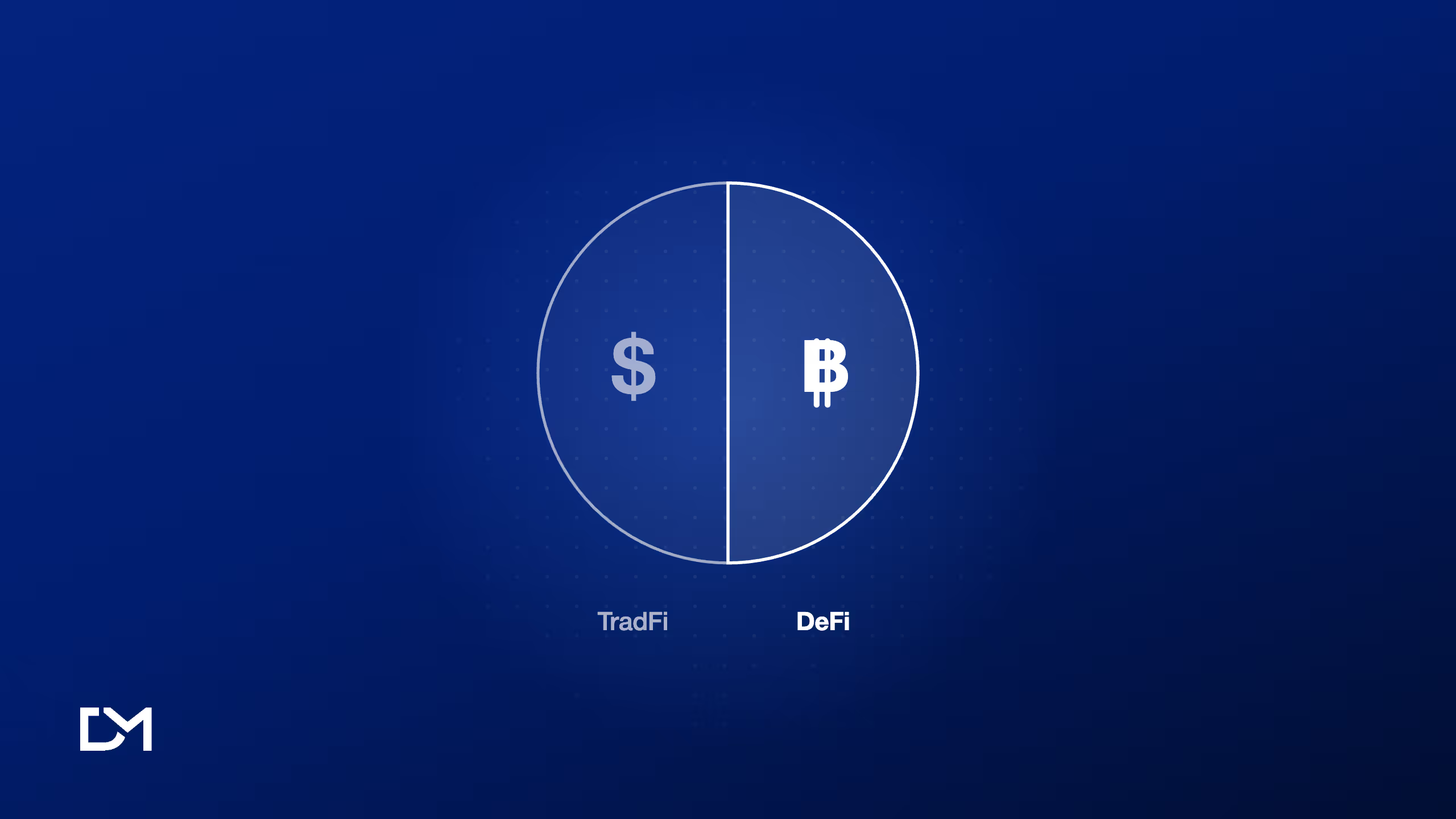
DeFi and traditional finance represent fundamentally different approaches to financial services, with DeFi offering greater transparency, accessibility, and user control while traditional finance provides regulatory protection, stability, and institutional support.
You've probably heard people claim that DeFi will completely replace traditional banking. Others insist that DeFi is too risky and traditional finance is the only safe option. Both extremes miss the nuanced reality. DeFi and traditional finance each have distinct advantages and limitations, and most people actually use both systems without realizing it. They might have traditional bank accounts for everyday expenses while earning yield through DeFi protocols on their crypto holdings. The future likely involves integration rather than replacement.
After learning about crypto financial advisors and investment strategies, understanding the fundamental differences between financial systems becomes crucial for making optimal choices.
Fundamental System Architecture
Traditional finance operates through centralized institutions that act as intermediaries for all financial transactions. Banks, brokerages, and payment processors control the infrastructure and maintain customer relationships. Every transaction involves multiple intermediaries who verify, process, and settle financial activities. Institutions use proprietary software and databases that aren't interoperable or transparent to users. Traditional finance operates within established regulatory frameworks with government oversight, consumer protections, and institutional insurance programs, but its services are typically limited by geographic boundaries.
DeFi operates through smart contracts on blockchain networks that execute automatically without human intermediaries. Users interact directly with protocols rather than institutions. Transactions occur directly between users through automated market makers and lending pools, eliminating many traditional intermediaries. DeFi protocols use open source smart contracts that anyone can audit, verify, and understand. Protocols work the same globally without geographic restrictions, and anyone can build on existing DeFi infrastructure or create new protocols without requiring permission from central authorities.
Cost Structure Comparison
Traditional finance costs include monthly maintenance fees of $5-25 for checking accounts and $10-50 for investment accounts, wire transfer fees of $15-50 domestically and $30-80 internationally, investment advisor fees of 0.5-2% annually, and loan origination fees plus ongoing interest charges. Multiple intermediaries each take spreads that are often invisible to end users but built into pricing structures.
DeFi cost structures are different. Blockchain network fees (gas) vary by network congestion, typically $1-50 per transaction on Ethereum but under $0.10 on layer 2 networks like Arbitrum or Base. Protocol fees run 0.05-0.3% per transaction. Most DeFi protocols have no minimum account sizes or maintenance fees, and all fees are visible before transaction execution with no hidden charges. DeFi protocols often share revenue with users through governance tokens or fee distributions, providing returns that traditional finance keeps internally.
Accessibility and Inclusion
Traditional finance requires extensive identity verification including government IDs and proof of address, established credit history for many services, minimum account sizes often ranging from $1,000 to $100,000 for investment services, geographic compliance limiting which services are available in which countries, and existing banking relationships as prerequisites for investment and lending access.
DeFi protocols are accessible to anyone with an internet connection and compatible wallet, without requiring permission, verification, or credit history. Most services have no minimum investment amounts, work identically globally regardless of user location or citizenship, and are available immediately without application processes or waiting periods. The 1.4 billion unbanked adults globally who have smartphones but lack access to traditional banking represent DeFi's most significant accessibility advantage.
Security Models and Risk Profiles
Traditional finance provides institutional-grade cybersecurity with fraud monitoring, FDIC insurance covering deposits up to $250,000 per account, regular audits and regulatory examinations, professional security teams managing institutional cybersecurity, and legal recourse through courts and regulatory agencies when problems occur. Users don't need to manage their own security infrastructure.
DeFi security is fundamentally different. Users are responsible for securing their own private keys and managing wallet security, requiring technical knowledge and discipline. Smart contract audits reduce risk but don't guarantee complete security. Open source code enables community security review but also makes attack vectors visible to malicious actors. Most DeFi protocols lack deposit insurance, meaning users bear full risk of smart contract failures or exploits. Blockchain transactions are irreversible, so user errors or fraudulent transactions cannot be undone through customer service.
Transparency and Control
Traditional financial institutions typically don't disclose their lending practices, investment strategies, or risk management details to customers. Banks use proprietary internal processes that customers cannot inspect or verify independently. Institutions can change terms, fees, and policies with limited notice, and can freeze accounts or restrict access based on internal policies that may not be transparent to users.
DeFi provides complete code transparency where all smart contract code is publicly visible and auditable. Real-time data shows total deposits, loans outstanding, interest rates, and fee generation. Many protocols enable token holders to vote on protocol changes, giving users direct input on operational decisions. Smart contracts execute exactly as programmed without human intervention, providing predictable and transparent operations. Third-party analytics can verify protocol claims and performance metrics using on-chain data.
Speed and Efficiency
Standard bank transfers take 1-3 business days to settle. Domestic wires process same-day. Cross-border payments can take 3-7 business days and involve multiple intermediary banks. Traditional finance operates during business hours with limited weekend and holiday processing. Stock trades settle in T+2.
Most DeFi transactions settle within seconds to minutes with immediate finality. Protocols operate continuously without business hours or holiday restrictions. DeFi enables complex multi-step atomic transactions that either complete entirely or fail entirely, eliminating partial execution risks. International DeFi transactions process at the same speed as domestic ones. Smart contracts can automate complex financial operations without human intervention, reducing processing delays.
Regulatory Environment and Innovation
Traditional finance operates under well-established regulatory frameworks with clear rules, oversight agencies, and enforcement mechanisms. Regulations provide consumer protections including deposit insurance, fair lending practices, and dispute resolution. New product development requires regulatory approval that can take months or years, and institutions prioritize stability over rapid innovation, though they have significant resources for development.
DeFi regulations are still developing in most jurisdictions, creating uncertainty about compliance requirements and legal status. Traditional regulatory frameworks weren't designed for decentralized systems without clear responsible parties, and DeFi protocols operating globally create complex jurisdictional questions. On the innovation side, developers can build and deploy new DeFi protocols without requiring approval from central authorities. Protocols can iterate quickly based on user feedback, integrate with each other like building blocks, and share innovations through open source development. Community-driven features often emerge from grassroots needs rather than institutional priorities.
Use Case Optimization
Traditional finance works best for everyday banking (checking accounts, bill payments, routine services), large loans like mortgages and business credit facilities with established underwriting processes, retirement accounts with tax advantages, insurance products for life and disability risk management, and complex financial planning and legal services requiring human expertise.
DeFi works best for high-yield savings where protocols often offer significantly higher yields than traditional savings accounts through lending and staking, international transfers that are faster and cheaper than wire services, investment access for smaller investors to opportunities not available through traditional channels, automated investment strategies and programmable finance products through smart contracts, and users seeking maximum control over their assets through self-custody.
Ready to understand how to optimally use both financial systems? Decentralized Masters teaches the proven ABN System for integrating traditional and decentralized finance strategies, helping you work with crypto financial advisors and develop investment strategies that leverage the best of both worlds.