

1. Solana: The High-Speed Blockchain Powering Real-Time Web3
Solana is one of the fastest and most cost-efficient Layer 1 blockchains in the crypto ecosystem. Launched in 2020, it was designed from the ground up to solve scalability bottlenecks without relying on Layer 2 solutions. By combining Proof-of-History (PoH) with Proof-of-Stake (PoS), Solana enables high throughput, sub-second finality, and ultra-low transaction fees, making it ideal for DeFi, NFTs, gaming, and payments.
Its biggest competitive advantage is raw performance: Solana can process tens of thousands of transactions per second compared to Ethereum's baseline of around 15-30 TPS on-chain. Developers building time-sensitive or high-frequency applications, like decentralized exchanges, prediction markets, and real-time games, often choose Solana because latency and cost directly affect user experience. Ongoing upgrades, most notably Firedancer, a new validator client built by Jump Crypto, are expected to push capacity further and improve network resilience.
The biggest challenge ahead is ecosystem growth, attracting developers, liquidity, and users at a pace that justifies Solana's valuation and can compete with Ethereum's deeply entrenched network effects. Solana's ecosystem has expanded rapidly since 2023, with NFT marketplaces, DEXs like Jupiter, and DePIN projects leading adoption. For investors, Solana represents a high-conviction bet on throughput-first design and a growing developer base.
2. Hyperliquid: Redefining On-Chain Trading Infrastructure
Hyperliquid is a purpose-built Layer 1 blockchain designed specifically for high-performance perpetual futures trading. Unlike general-purpose chains, Hyperliquid ships with a native on-chain central limit order book, a first for Layer 1 blockchain infrastructure, enabling the kind of low-latency, institutional-grade trading previously only possible on centralized exchanges.
Built on a custom consensus mechanism optimized for speed, Hyperliquid offers sub-second block times and the ability to match trades at a performance level comparable to centralized platforms. This makes it uniquely positioned to capture trading volume migrating from centralized exchanges to decentralized alternatives. Early traction has been exceptional: Hyperliquid has rapidly become one of the largest decentralized perpetuals platforms by volume.
The investment thesis is straightforward: if DeFi derivatives trading continues to grow and decentralized platforms capture meaningful market share from centralized exchanges, Hyperliquid's purpose-built infrastructure gives it a durable technical moat. The challenge is maintaining that technical edge as general-purpose chains adopt similar capabilities and competition in the on-chain derivatives space intensifies.
3. Sui: Object-Centric Blockchain for Scalable Digital Ownership
Sui is a Layer 1 blockchain built by Mysten Labs, founded by former Meta engineers who worked on the Diem blockchain project. It introduces a novel object-centric data model that differs fundamentally from account-based models like Ethereum. In Sui's model, each digital asset is a distinct object with its own state and ownership, which enables parallel transaction execution, allowing unrelated transactions to be processed simultaneously without contention.
This architectural choice gives Sui significant scalability advantages for use cases involving high volumes of independent asset transfers, like gaming items, NFTs, and payments. Sui's programming language, Move, was also developed for safe, verifiable asset management, making it well-suited for financial applications where security and correctness are critical.
Sui is still in its growth phase, with an expanding DeFi ecosystem, NFT platforms, and gaming integrations building on its infrastructure. Its technical differentiation is clear; the question for investors is whether object-centric design and Move adoption can drive the network effects needed to compete with more established chains.
4. Toncoin: Web3 Infrastructure Built for Mass Adoption via Telegram
Toncoin (TON) is the native asset of The Open Network, a blockchain originally developed by Telegram's founders and now maintained by an independent foundation. TON's defining characteristic is its deep integration with Telegram, giving it access to one of the world's largest messaging platforms with over 900 million users.
The biggest advantage, and risk, for TON is its close relationship with Telegram. On the upside, Telegram's built-in wallet and mini-app ecosystem give TON a real distribution channel that most blockchains lack. Payments, gaming, and Web3 applications built on Telegram's platform expose hundreds of millions of users to TON-based infrastructure without requiring them to download a separate app. On the downside, TON's growth trajectory is heavily dependent on Telegram's continued support, regulatory environment, and user adoption of Web3 features.
For investors, TON represents a unique distribution-first bet: a blockchain that could achieve broad adoption not through developer-first ecosystem building, but through integration with an existing consumer platform at scale.
5. Ethereum: The Settlement Layer of Web3
Ethereum remains the most widely used and battle-tested smart contract platform in the world. As the foundation for the overwhelming majority of DeFi protocols, NFT marketplaces, and tokenized assets, Ethereum holds a dominant position measured by total value locked, and EVM standard, making it the default platform for institutional DeFi and compliant tokenization projects.
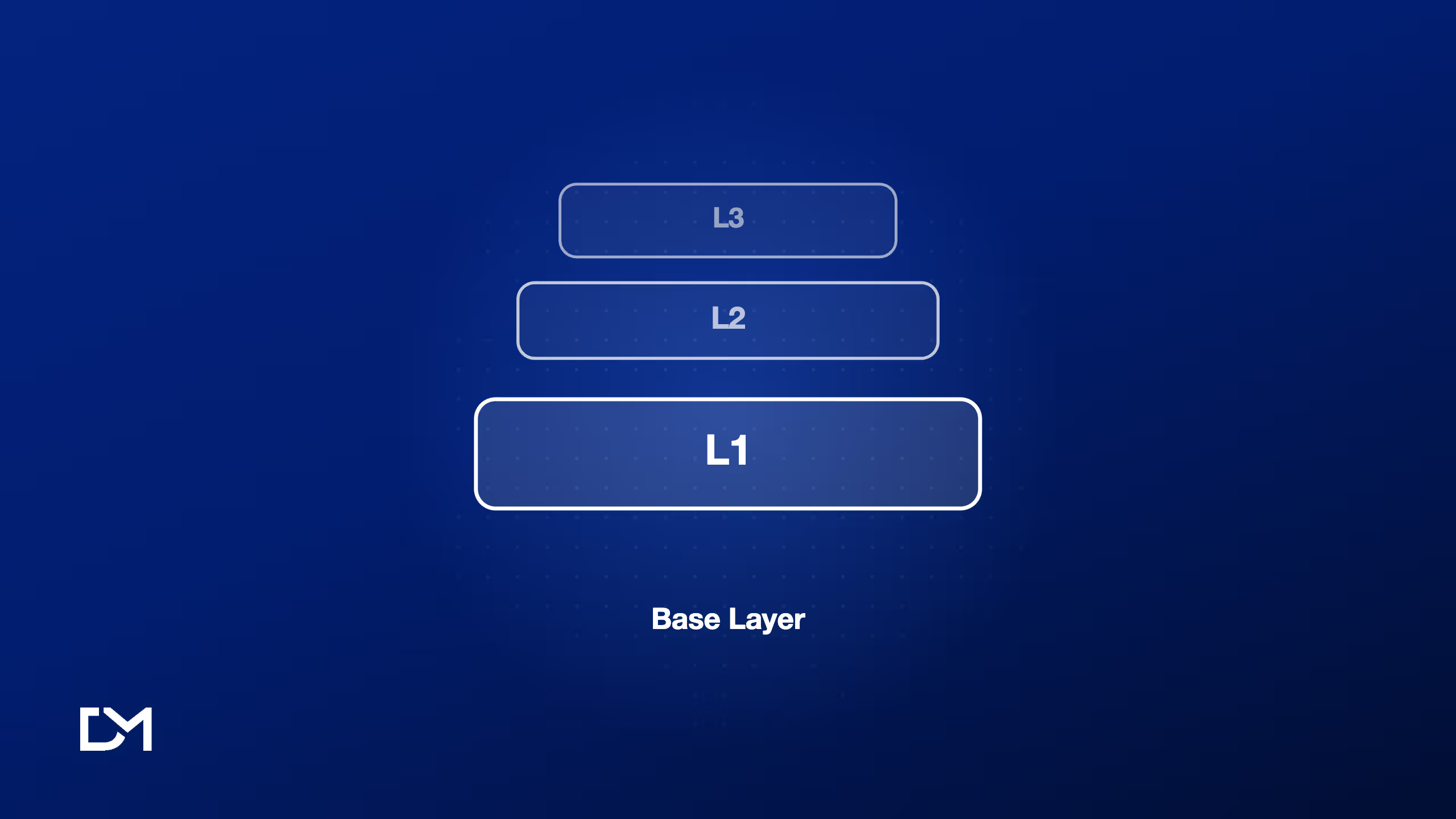
The Ethereum roadmap has shifted toward becoming a settlement layer, with Layer 2 networks like Arbitrum, Optimism, and Base handling the bulk of user transactions while Ethereum provides security, decentralization, and finality. EIP-1559 introduced a fee-burning mechanism that makes ETH deflationary under high network activity. The transition to proof-of-stake dramatically reduced energy consumption and introduced staking rewards, aligning long-term holders with network security.
Ethereum's primary risk is the time it takes to deliver on its roadmap. Layer 2 fragmentation, slower innovation cycles compared to newer chains, and competition from performance-oriented L1s are real concerns. But Ethereum's strengths, developer mindshare, institutional trust, regulatory recognition, deep liquidity, and a relentlessly iterative research culture focused on decentralization, MEV mitigation, and scalability, reinforce its long-term vision.
Ethereum may not be the fastest chain, but it continues to be the most trusted foundation for decentralized innovation.