


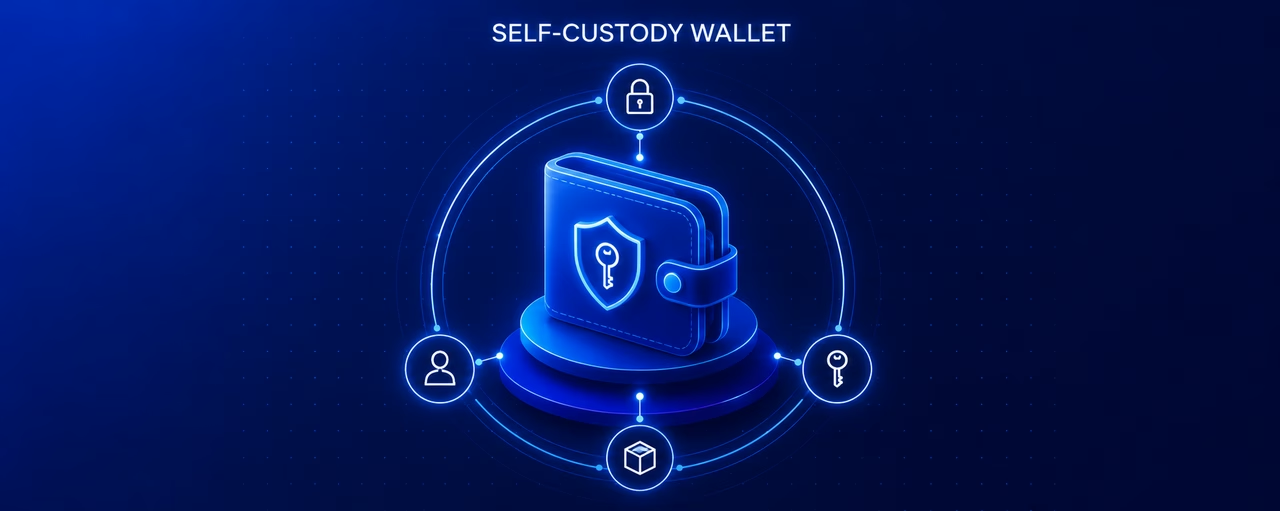
The right wallet depends on what you hold, how often you move it, and how much you value your own peace of mind. Here is an honest breakdown.
Choosing the best self-custody wallet in 2026 is less about finding one perfect device and more about matching a wallet to how you actually invest.
A self-custody wallet, sometimes called a non-custodial or cold wallet, keeps your private keys in your own hands instead of on an exchange.
That single difference is the whole point of the phrase you have probably heard a hundred times.
Not your keys, not your coins.
When you hold assets on an exchange, you own a claim against that company. When you hold them in self-custody, you own the asset itself.
The trade-off is responsibility. No support line can reset a lost seed phrase. So the goal is not just picking a secure device, it is picking one you will actually use correctly. Below are five hardware wallets worth trusting in 2026, the kind of investor each one suits, and the mistakes that cost people more than any hacker ever will.
5 ‘Must Haves’ for Every Custody Wallet
Before the list, the criteria. Every credible hardware wallet keeps your keys offline, so the real differences come down to 5 things:
- Which assets does it support
- How it signs transactions (USB, Bluetooth, or fully air-gapped via QR codes)
- Whether its firmware is open-source and independently reviewable
- How does it handle backup and recovery?
- How much friction are you willing to accept for extra security?
A Bitcoin-only holder and an active DeFi user do not need the same tool. Weigh these against your own habits rather than chasing whatever tops a generic ranking.
The 5 best self-custody wallets in 2026
These are established devices with real track records, not the latest launch chasing headlines. Each one wins for a specific kind of person.
1. Ledger (Nano X, Nano Gen5, Flex): best for broad asset support
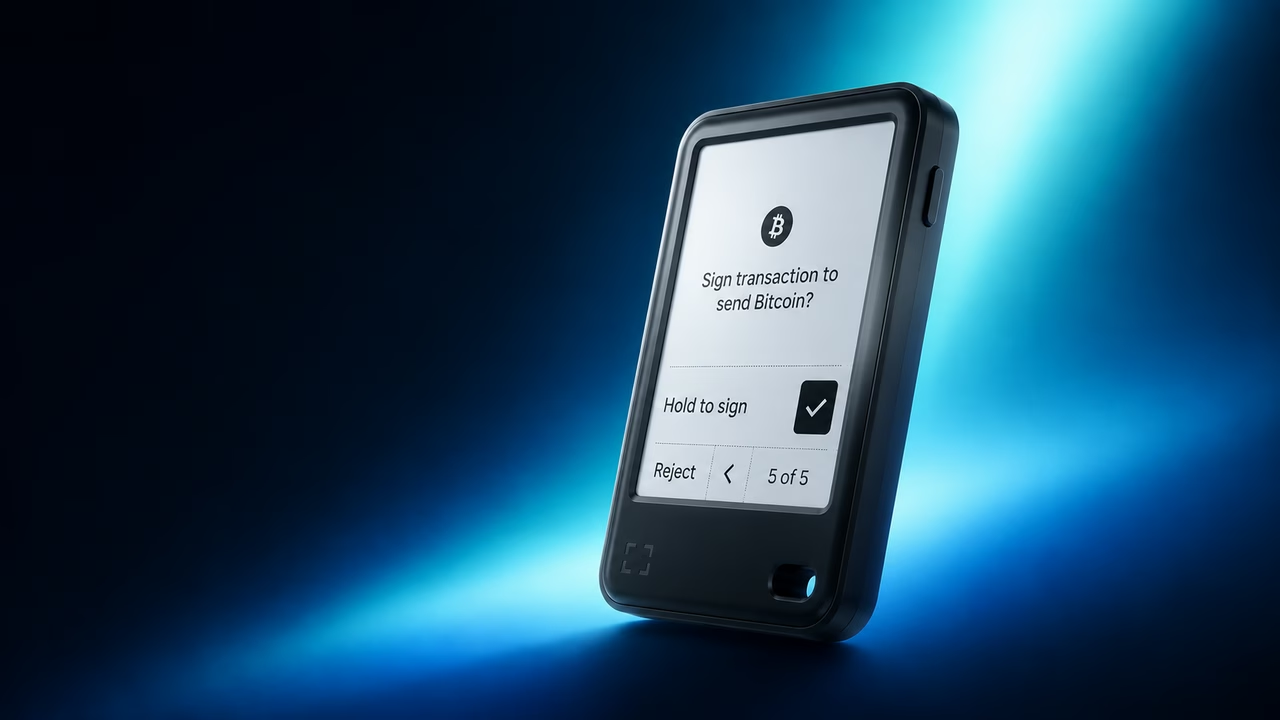
Ledger remains the default choice for investors who hold a wide range of assets. Its wallets support more than 15,000 coins and tokens, and the Ledger Live app combines buying, swapping, staking, NFTs, and portfolio tracking in one place.
That breadth and the mobile experience make it the smoothest day-to-day option for most people.
Worth knowing: Ledger's firmware is not fully open-source, and its 2023 announcement of an optional key-recovery service drew heavy criticism from users who felt it cut against the promise that keys never leave the device.
Ledger paused the rollout and made it opt-in. If you value maximum transparency, that history matters.
Bottom Line: The most versatile wallet on the market, ideal if you hold a bit of everything, as long as you are comfortable trading a little transparency for that convenience.
2. Trezor (Safe 5, Safe 3): best for open-source transparency

Trezor is the pick for people who want to verify, not just trust. Its firmware is open-source, its security model is transparent, and the setup pushes you to confirm every step yourself.
The Trezor Safe 5 (around $129) is the flagship, while the Safe 3 (around $59) is a strong budget entry point.
It supports over 9,000 assets, slightly fewer than Ledger, and its iOS app is more limited than its Android one. For a transparency-first investor who mostly holds major assets, it is hard to beat.
Bottom Line: The wallet for people who would rather verify than trust, best if you hold mostly major assets and value openness over the widest possible coin support.
3. NGRAVE ZERO: best for large holdings and maximum security

The NGRAVE ZERO is built for investors who protect significant capital and want the safest storage available. It is the only consumer crypto device to reach EAL7 security certification, and it is completely air-gapped: no USB data connection, no Bluetooth, no WiFi, no NFC. Every transaction is signed by scanning QR codes.
At roughly $398, it is a premium product, and its companion app offers narrower direct DeFi access than Ledger. For a long-term holder who prioritizes security over convenience, that is often an acceptable trade.
Bottom Line: The most secure wallet money can buy, worth the premium if you are storing serious capital long term and happy to trade everyday convenience for maximum protection.
4. Keystone: best air-gapped wallet for DeFi users

Keystone bridges the gap between maximum isolation and everyday usability. It is fully air-gapped over QR codes, runs open-source firmware, and supports multisig and Shamir backups.
Crucially, it connects to popular software interfaces like MetaMask and Rabby via QR scanning, so you can interact with DeFi applications while keeping your keys on an offline device. For an active on-chain user who refuses to give up air-gapped security, this is the sweet spot.
Bottom Line: The best of both worlds, air-gapped security with real on-chain usability, ideal for active users who want to stay connected without putting their keys online.
5. Coldcard: best for Bitcoin-only holders

Coldcard is a specialist. It is built for serious Bitcoin self-custody, with fully air-gapped, PSBT-based workflows and strong anti-coercion features like duress PINs.
The trade-off is deliberate: it is Bitcoin-focused, with little or no altcoin support. If Bitcoin is the bulk of what you hold and you want a device designed around that single asset, Coldcard is the enthusiast's choice.
Bottom Line: The purist's Bitcoin wallet, unbeatable if BTC is your core holding and you want a device built for one job, but not the pick if you hold much else.
At a glance: the 5 wallets compared
Before the deep dives, here is the quick version. This snapshot shows how the five stack up on the things that actually differ, so you can find your shortlist fast.

Seedless and MPC wallets: a different approach
Not every self-custody wallet relies on a written seed phrase. Multi-party computation (MPC) wallets such as Zengo split your private key into shares held across multiple devices or parties, so no single point ever holds the whole key, and there is no seed phrase to lose or photograph.
Card-based devices like Tangem take a similar seedless route. These reduce the most common cause of lost crypto, human error with backups, at the cost of a different security model, which you should understand before relying on it.
They are worth a look for anyone who knows a paper backup is realistically going to end up in a drawer.
4 Red flags to avoid

The device is rarely the weak link. The person using it usually is. A few rules that prevent most disasters:
- Never buy secondhand or from a third-party marketplace. Buy direct from the manufacturer. A tampered device or a pre-filled seed phrase is a straightforward way to lose everything.
- Never store your seed phrase digitally. No photos, no cloud notes, no password managers for the phrase itself. Write it on paper or stamp it into steel, and keep backups in separate secure locations.
- Never enter your seed phrase on a website or in an app. A real hardware wallet never asks for it. Any prompt that does is a scam.
- Avoid SMS-based two-factor authentication. SIM-swap attacks make it weak. Use an authenticator app or a hardware security key.
More crypto has been lost to forgotten backups and self-inflicted mistakes than to every exchange hack combined. The best self-custody wallet in the world cannot protect you from a seed phrase written on a sticky note.
A wallet is only as good as the person using it
Here is the honest part. We do not sell a wallet, so we have no device to push on you. Decentralized Masters is an investment education and research company covering everything from stocks to digital assets, and self-custody is one of the first things we teach members, because a portfolio you cannot safely hold is not really yours.
For readers doing broader due diligence before joining any structured DeFi education program, this Reddit discussion on whether Decentralized Masters is good or bad to join gives additional community context.
Picking a device is the easy 10%. The other 90% is knowing how to set it up, back it up, size your risk, and actually put those assets to work. There are also member-led discussions on Reddit that show how some users describe moving from scattered self-research into a more structured learning process.
That is the skill, and it is what turns a gadget in a drawer into genuine ownership.
ABN System
Learn to hold and grow your assets, the right way.

Our free ABN System training walks through the exact framework members use to build and protect wealth across asset classes, not just store it safely:
- Phase A, All-Weather: a diversified portfolio you hold yourself, built to withstand any market.
- Phase B, Become the Bank: turning those assets into income instead of leaving them idle.
- Phase N, Native Markets: reaching early-stage opportunities without risking your core capital.
Frequently asked questions
What is the best self-custody wallet for beginners?
For most beginners holding a mix of assets, Ledger offers the gentlest learning curve thanks to its all-in-one app. If open-source transparency matters more to you, the Trezor Safe 3 is an affordable, well-documented starting point.
Is a self-custody wallet safer than an exchange?
For long-term holdings, yes. Self-custody removes the counterparty risk that comes with leaving assets on an exchange, where a freeze, hack, or insolvency can put your funds out of reach. The trade-off is that you become fully responsible for your keys and backup.
What happens if I lose my hardware wallet?
The device itself is not the point of failure. As long as you have your recovery seed phrase stored safely, you can restore your assets to a new wallet. Lose both the device and the backup, and the funds are gone for good.
Do I need a hardware wallet if I only own a little crypto?
Not necessarily. For small amounts, a reputable software or MPC wallet may be enough. As your holdings grow, moving to a dedicated hardware or air-gapped device becomes worth the cost and effort.
Sources
Disclaimer: This article is for educational and informational purposes only and does not constitute financial, investment, legal, or security advice. Decentralized Masters is an investment education and research company; it does not sell hardware wallets or financial products and makes no guarantee of results. Product names, prices, and specifications are approximate and accurate as of mid-2026; verify current details with each manufacturer. Digital assets carry risk, including the possible loss of capital. Always do your own research before purchasing a wallet or making any investment decision.